
Home Office Design For A Small Space: 11 Nifty WFH Solutions
The shift to remote work has transformed spare bedrooms, kitchen corners and even cupboards into workspaces across the UK. If you’re staring at a tiny nook wondering how to create a functional office, you’re not alone. According to a 2024 survey by the Office for National Statistics, 38% of British workers now operate from home at least part-time, yet 67% report struggling with limited space. A home office design for a small space isn’t about squeezing in a desk and chair – it’s about crafting an environment that supports your productivity without overwhelming your living area.
The challenges of creating a productive workspace in a compact area are significant. You might be sharing your workspace with others, dealing with distractions or simply feeling cramped. The mental impact of a cluttered or uncomfortable workspace shouldn’t be underestimated either – research from the University of Exeter shows that workers who have control over their workspace design are up to 32% more productive.
From multipurpose furniture to clever storage hacks, this article provides practical solutions for those balancing professional needs with spatial constraints. Whether you’re permanently working remotely or establishing a hybrid routine, these ideas will help transform even the smallest corner into a space where you can thrive professionally while maintaining home comfort.
Understanding Your Space: The First Step to Optimisation
Taking time to assess your available area pays dividends before purchasing any furniture or accessories. Measuring your space accurately helps avoid costly mistakes and disappointment when that perfect desk won’t fit through the doorway. Think about traffic flow, natural light sources and proximity to power outlets.
Organisation ideas for working from home begin with a clear understanding of your work requirements. Make a list of essential equipment and supplies you use daily. This inventory helps prioritise what truly needs space on your desk versus what can be stored elsewhere.
When creating a home office design for a small space you must be intentional about every element. The UK-based Interior Design Institute suggests allocating at least 1.8 square metres as an absolute minimum for a functional workspace, though more is certainly preferable if available.
Be realistic about your spatial constraints, but also creative. Look for “dead space” that might be utilised – the area under stairs, a deep cupboard, an unused corner or even a hallway alcove. Some of the most effective home offices emerge from previously overlooked spaces.
The Foundation: Essential Furniture Choices
Your desk and chair form the backbone of your workspace, and choosing wisely is crucial when space is limited.
Small-Space Desk Solutions
When selecting a desk, think about both footprint and functionality. Wall-mounted folding desks are particularly valuable for extremely limited spaces, offering a work surface that can disappear when not in use. UK retailers like John Lewis and IKEA offer several affordable options starting from around £85.
Corner desks maximise awkward spaces while providing more surface area than you might expect. Your home office desk arrangement in these scenarios should prioritise your primary work zone directly in front of you, with secondary items positioned to the sides for easy access.
If floor space is extremely limited, a floating desk – essentially a wall-mounted shelf at the appropriate height – might be suitable. These minimal surfaces can be surprisingly effective when paired with proper storage solutions.
Ergonomics Matter, Regardless of Size
Never compromise on seating comfort for the sake of space. Ergonomic home office furniture is essential for preventing physical strain during long workdays. Look for chairs with proper lumbar support, adjustable height and armrests that allow your feet to rest flat on the floor with arms at a 90-degree angle to the desk.
For extremely tight spaces, an ergonomic kneeling chair or ball chair might work well, as they typically have smaller footprints than traditional office chairs while promoting better posture. The UK Furniture Industry Research Association recommends testing chairs before purchase whenever possible, as personal comfort varies widely.
The best chairs for home office environments balance comfort with space efficiency. Models like the HÅG Capisco from Flokk offer ergonomic benefits with a smaller profile than traditional executive chairs, though quality options typically start from £250.
Vertical Thinking: Maximising Wall Space
When floor space is limited, look upward. Walls provide vast untapped potential for both storage and functionality.
Strategic Shelving
Install floating shelves above your desk to create storage without consuming precious floor space. You home office storage solutions should be positioned for easy access to frequently used items while keeping visual clutter to a minimum.
Modular shelving systems allow for customisation as your needs change. UK companies like String offer stylish systems that combine shelving with desk space and can be reconfigured as needed.
The Wall as Workspace
Wall-mounted organisers, pegboards and magnetic strips can keep essential tools visible yet off your desk. A wall-mounted monitor arm can free up desk space and position your screen at the optimal height for neck comfort.
Walls can also serve as boundaries. In open-plan living spaces, a strategically placed bookshelf can create a visual partition that helps separate your work area from living space – an important psychological boundary when working from home.
Lighting: The Overlooked Productivity Factor
Proper illumination affects everything from eye strain to mood and productivity. Any home office lighting solutions should combine natural light with task-specific artificial lighting.
Position your desk to capture natural daylight when possible, ideally perpendicular to windows to reduce glare on screens. For artificial lighting, a combination of ambient and task lighting works best. The British Association of Ophthalmologists recommends desk lamps that direct light onto work materials rather than shining directly into your eyes.
LED lighting has revolutionised home office options, offering energy-efficient illumination in compact forms. Adjustable-arm desk lamps can be positioned precisely where needed, or clip-on lights might work if desk space is extremely limited.
Video conferencing has added new lighting considerations. Ring lights or small LED panels can significantly improve your appearance on camera without occupying much space.
Home Office Design For A Small Space: The Multipurpose Approach
When square footage is severely limited, furniture that serves multiple functions becomes invaluable. This approach to creating your home office maximises utility while minimising spatial requirements.
Dual-Purpose Furniture
Think about desks that transform into dining tables, ottomans with hidden storage or murphy beds with integrated desk systems. UK company Clei specialises in transformable furniture that shifts between work and living configurations with minimal effort.
Secretary desks – those with fold-down work surfaces and built-in storage – have made a comeback for good reason. These traditional pieces conceal work materials when not in use while providing a designated workspace when needed.
Convertible Zones
If a dedicated office isn’t possible, create a convertible workspace using movable elements. A rolling desk can be positioned for work during the day and tucked away in the evening. Room dividers or decorative screens can temporarily section off work areas when needed.
How to improve home working productivity often involves creating mental as well as physical boundaries. These convertible solutions help signal to your brain when it’s time to focus on work versus relaxation, even within the same physical space.
11 Nifty WFH Solutions for Space-Challenged Workers
Now let’s examine specific solutions that address the challenges of limited space while maintaining productivity and comfort:
1. The Wall-Mounted Workstation
Minimalist home office design reaches its zenith with wall-mounted systems that fold away completely when not in use. UK-based company IKEA’s IVAR system can be adapted with hinges to create a fold-down desk with integrated storage. When closed, these units protrude just inches from the wall, reclaiming valuable floor space.
Installation is straightforward with basic DIY skills, though ensure wall fixings are appropriate for the weight being supported. These solutions work particularly well in bedrooms or living rooms where a permanent desk would dominate the space.
2. Corner Optimisation System
Corners represent some of the most underutilised space in homes. A purpose-built corner desk will maximise these awkward angles, offering more workspace than you might expect from its modest footprints.
Work from home productivity hacks can involve making use of these overlooked spaces. The key is choosing corner furniture that doesn’t extend too far along either wall while providing sufficient depth at the corner point for comfortable working.
Floating corner shelves installed above such desks multiply available storage without consuming additional floor space. This vertically integrated approach creates a comprehensive workstation within a minimal footprint.
3. Cable Management Solutions
Nothing makes a small space feel more cluttered than tangled cables. Home office cable management ideas range from simple cord clips to comprehensive systems that completely conceal connectivity.
Cable trays mounted under desks keep wires bundled and off the floor. Cable sleeves group multiple cords into a single tidy tube. Look for furniture with built-in cable management features when making purchasing decisions.
Wireless technology has significantly reduced cable clutter. Prioritise Bluetooth peripherals and wireless charging solutions where practical. When cables are necessary, opt for shorter lengths specifically measured for your setup rather than allowing excess cord to accumulate.
4. Screen Solutions
The best monitor for a home office will depend on your requirements but it should include mounting options. A monitor arm clamps to the desk edge or mount to the wall, reclaiming valuable desk space while positioning your screen at the optimal height for neck comfort.
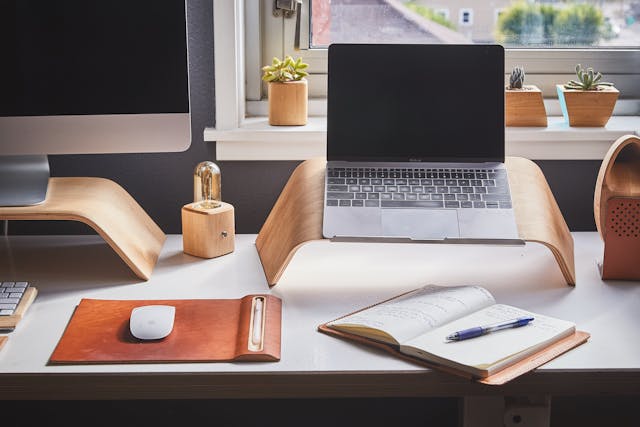
For those using a laptop, a vertical stand allows the device to occupy minimal desk space when used with external peripherals. A convertible or ultrawide monitor can replace a dual-screen setup, reducing the overall footprint while maintaining screen real estate.
The newest generation of portable monitors, which connect via USB-C and can be easily stored when not in use, provide additional screen space for complex tasks without requiring permanent desk allocation.
5. Acoustic Management for Small Spaces
Working in close quarters often means dealing with noise challenges, particularly in shared households. Noise reduction for a home office becomes essential for concentration and professional call quality.
Acoustic panels need not be industrial-looking or space-consuming. Decorative fabric panels, strategic furniture placement and soft furnishings all contribute to improved acoustics. Companies like UK-based Woolcott & Smith offer stylish acoustic solutions designed specifically for home environments.
Noise-cancelling headphones represent one of the most space-efficient solutions for acoustic privacy. Models from Bose and Sony provide exceptional isolation without consuming any meaningful space when not in use.
6. Flexible Lighting System
In limited spaces, lighting fixtures should be adaptable and compact. A clamp-on desk lamp eliminates the need for a space-consuming base. A wall-mounted adjustable fixture provides directed light without occupying any desk surface.
LED light strips mounted under shelving for indirect illumination don’t create glare on screens. These low-profile solutions provide ambient lighting that reduces eye strain during long work sessions.
Proper lighting serves both functional and aesthetic purposes in small spaces. Well-lit areas typically feel more spacious and inviting, making strategic illumination doubly valuable in compact offices.
7. Vertical Filing and Paper Management
Traditional filing cabinets consume valuable floor space that small home offices simply can’t spare. Wall-mounted file holders, vertical magazine racks repurposed for documents and a behind-door storage system offer alternatives that keep papers organised without sacrificing square footage.
The UK’s National Archives recommends digitising documents where possible, significantly reducing physical storage requirements. Productivity tools for remote work should include a quality scanner and secure cloud storage solution for this purpose.
For papers that must be kept physically, a classification system that prioritises frequent-use documents in an accessible location while archiving less-needed paperwork in more remote storage areas of your home makes sense.
8. Sit-Stand Adaptability in Minimal Space
The health benefits of alternating between sitting and standing are well-documented, but traditional standing desks have substantial footprints. A standing desk for a home office doesn’t necessarily mean replacing your existing workspace entirely.
A desk converter placed atop a standard desk provides height adjustability without requiring additional floor space. Models from Varidesk and Flexispot offer a stable platform that rises vertically rather than extending outward when adjusted upward.
A wall-mounted adjustable-height desk represents another space-efficient option, though installation is more complex. These systems can be particularly valuable in extremely limited spaces where even the smallest traditional desk would feel imposing.
9. Smart Storage Integration
When every centimetre counts, storage must be strategically integrated throughout the workspace. Budget friendly home office storage solutions include repurposing household items like spice racks for supplies, installing pegboards for frequently used tools and utilising the often-forgotten space under the desk.
Magnetic strips mounted to walls or the sides of metal furniture provide zero-footprint storage for metal objects like scissors, staplers and paper clips. A small shelving unit on castors can be rolled away when not needed and double as a printer stand or auxiliary work surface.
Furniture with hidden storage compartments – an ottoman that opens, a desk with integrated drawers or seating with under-lid storage – all maximise functionality without increasing spatial requirements.
10. Virtual Background Solution
Video conferencing has made our workspace backgrounds suddenly visible to colleagues and clients. For those working in a bedroom or a shared space, this presents obvious challenges. A home office backdrop for meetings can be compact yet effective.
One option could be a collapsible background that mounts to a wall or ceiling and pulls down only when needed for calls. Alternatively, a portable screen on a stand provides a flexible barrier that can be positioned precisely where needed and stored flat when not in use.
Even a strategically placed bookshelf, mounted floating shelf with curated objects or a simple piece of framed artwork can create a professional background zone requiring minimal space yet conveying professionalism during video calls.
11. Digital Organisation System
Physical space constraints can be partially offset through exceptional digital organisation. Home office productivity apps like Notion, Trello and Evernote provide virtual workspaces that reduce dependence on physical materials.
Cloud storage solutions eliminate the need for extensive paper files or reference materials. Project management software centralises information that might otherwise require physical tracking systems. Digital notebooks replace multiple physical journals and notepads.
These solutions extend your workspace beyond physical limitations while reducing visual and physical clutter in your environment. The British Computer Society recommends establishing a digital filing system with the same care you would apply to physical organisation for maximum efficiency.
Putting It All Together: A Holistic Approach
Creating an effective home office in limited space requires integrating multiple strategies tailored to your specific constraints and work needs. The best home office setup ideas don’t emerge from following a single template but rather from thoughtfully combining elements that address your unique challenges.
Begin with honest assessment of both your spatial constraints and work requirements. Prioritise ergonomics and essential functions over aesthetics initially, though visual appeal remains important for spaces you’ll occupy daily.
Implement solutions incrementally rather than attempting complete transformation at once. This approach allows for adjustments based on what actually works in practice rather than theory. Common home office productivity tips consistently emphasise the importance of testing and refining your setup over time.
Small-space offices require more frequent evaluation and adjustment than larger workspaces. Schedule periodic reviews of your setup to identify what’s working well and what could be improved.
Psychological Aspects of Small-Space Working
The mental impact of your workspace extends beyond physical comfort. Research from the University of Cambridge suggests that personalisation of even very small workspaces significantly impacts job satisfaction and productivity.
Include elements that bring joy and inspiration without consuming valuable space. A single small plant, meaningful photograph or artwork that resonates with you can transform how you feel about your workspace without requiring significant room.
Any work from home organisation ideas should include strategies for mental separation between work and personal life, particularly challenging in small spaces. Establish rituals that signal transitions – perhaps covering your workspace, changing lighting or simply tidying away work materials completely at day’s end.
Small Space, Big Potential
Creating a home office design for a small space certainly presents unique challenges, but limitations often spark creative solutions that wouldn’t emerge in more spacious environments. The constraints of compact working require thoughtfulness about priorities, innovative approaches to standard office elements and vigilance against clutter.
The remote work revolution has spawned an entire industry dedicated to space-efficient home office solutions, with British companies at the forefront of many innovations. From furniture manufacturers developing compact ergonomic pieces to technology companies creating smaller, more powerful tools, the resources available to small-space workers have never been more abundant.
As we continue adapting to evolving work patterns, the ability to create effective workspaces within our homes – regardless of their size – remains a valuable skill. The solutions outlined here offer starting points, but the most effective small office spaces reflect their owners’ specific needs, preferences and working styles.
With thoughtful implementation of these strategies, even the most modest space can support productive, comfortable and professional work. The key lies not in the square footage available but in how intelligently that space is utilised.